Entdecke die Menschheit. Science fiction and space travel are among the most profoundly humanising endeavours we have. Worth every billion — for the guidance they give us back. Let’s make it ours, too.
It’s such a relief.
Science fiction and reality (also known as non fiction) answering our most fundamental questions — again — at the same time, almost as if they had agreed on it. Who are we? What do we want to do with our existence? What is science actually for? Who do we like to be?
I won’t pretend I’m not tired of the default answer. Get rich. Influence someone with something. Disrupt. I understand the appeal, and I’ll leave the debate to others. But for me, that has never been the point. The point is the joy of being human. Something that can only be achieved together and not alone (auch wenn wir uns das manchmal glauben machen wollen). The joy of being here, together, on this particular rock, at this particular moment — and actually noticing it.
Science, at its best, does exactly that. It doesn’t drive us apart. It hands us the key.
There is something like a synchronicity in the fact that a (I must admit wonderful) science fiction film called Project Hail Mary and the Artemis II expedition arrived at almost the same moment, both putting this question back at the centre, giving us something we have been missing: orientation. Focus. A new hope.
As a songwriter, I have been living with this question for a while. “What’s the character of earth? / That’s the gravity of hearts.” I wrote those lines for a song in 2025 — a small, strange love story set in the Space Age, full of nostalgia for the golden age of space travel. A garden at the edge of the world. A rendezvous that was always just out of reach. A lonely orbit, waiting for realignment.
And I kept asking myself: why are fewer and fewer people asking this question? Or are they asking it — and we simply can’t hear them anymore? Which is, of course, a strange thing to claim in the age of the internet.
Four extraordinary human beings just gave us an answer. We are on a journey together. Let’s see where it takes us.
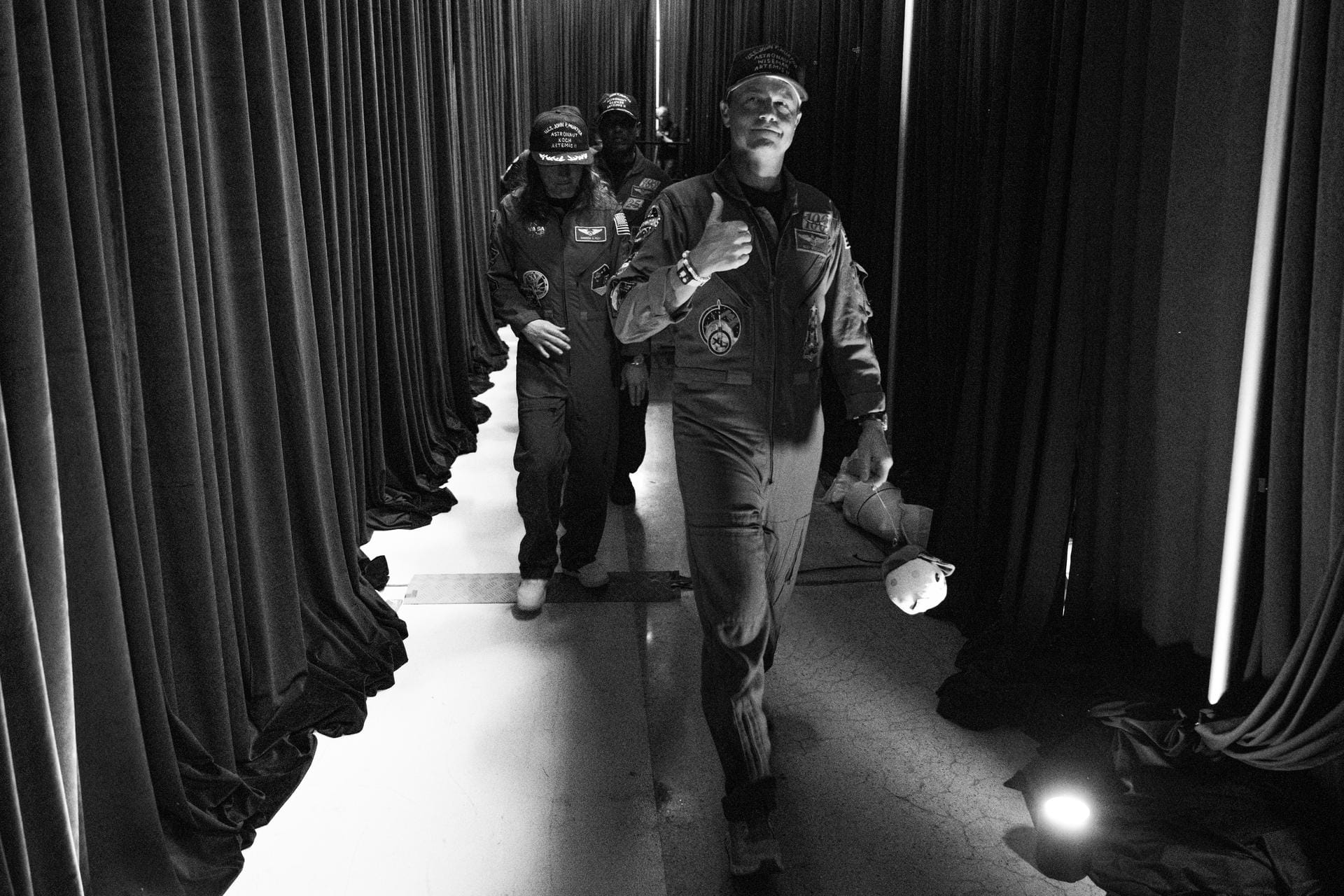
On April 11, 2026, Christina Koch stepped onto a stage at Ellington Field in Houston — less than 24 hours after splashing down in the Pacific following the Artemis II mission, the first crewed lunar flyby in more than half a century. She had just become the first woman to travel to the moon. And what she chose to talk about wasn’t the record or the science. It was the question of what makes a crew.
“A crew is a group that is in it all the time, no matter what — stroking together every minute with the same purpose, willing to sacrifice silently for each other, that gives grace, that holds accountable.”
She paused. Turned to face her three crewmates, her back to the audience.
“A crew has the same cares and the same needs — and a crew is inescapably, beautifully, dutifully linked.”
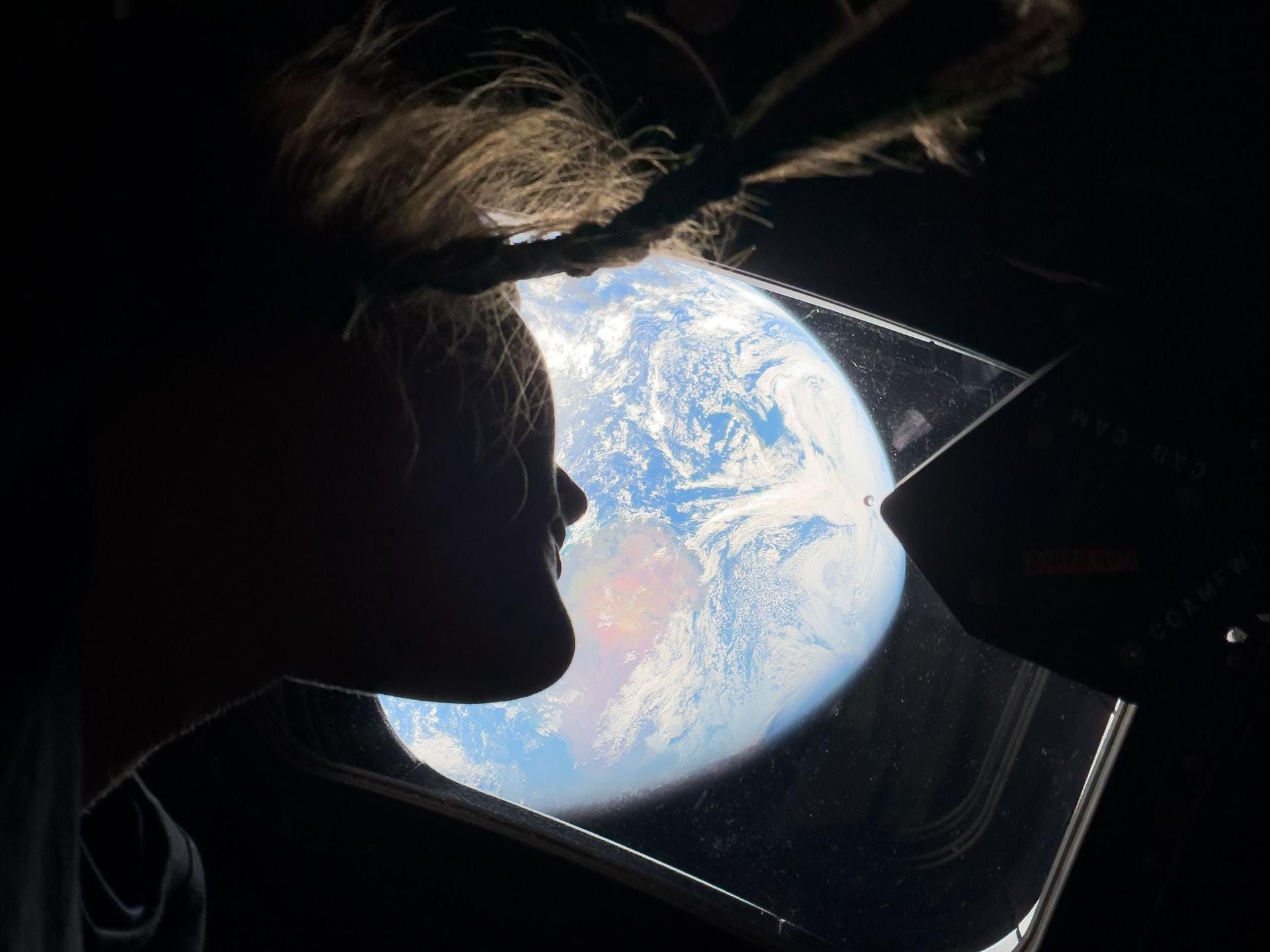
Then she described Earth through the window of Orion: a lifeboat, suspended in absolute darkness. And she landed here:
“Planet Earth — you are a crew.”
We are — hopefully — all poets, some with very grumpy voices, in our own way. And there is something rare and wonderful about people who carry that into places most of us will only dream of — who reach the edge of the known world and return with an idea and a language to transmit it to us. Christina Koch is a scientist and an engineer. And yet, at the threshold of one of humanity’s greatest technical achievements, she reached for words to name what the mission truly meant — for her, and for all of us.
Because here is what strikes me about space exploration that rarely gets said plainly: when human beings leave Earth and look back, the discovery is never just scientific. It is always, in the end, about us. About what we are to each other. Every mission that has pushed further into the dark has returned with an answer about the small, fragile, irreplaceable thing floating in it. The blue marble.
These endeavours are worth every cent, every billion. Not for the technological progress — but for the guidance they give us back. That is the real value. Orientation.
This is the belief at the centre of my work: technical progress without humanity is just meaningless velocity. Whether in orbit, in a brand strategy session, or in the middle of an AI-driven economy that moves faster than most people can follow — the real mission is always the same. Discover humanity. Entdecke die Menschheit!
Thank you, Reid, Victor, Christina and Jeremy. Thank you for being such beautiful extraordinary human beings.
“What’s the Character of Earth” is the opening track of my album The Ascent of Women. The title question was borrowed from a philosophy seminar at Heinrich-Heine-Universität Düsseldorf — a question that has stayed with me ever since. The bridge — “Don’t go to industry / Come to Huntsville” — echoes a real telegram Wernher von Braun sent to his colleague Jesco von Puttkammer, inviting him to join the Apollo programme. Von Puttkammer was also a technical advisor on Star Trek: The Motion Picture (1979). Both men had been inspired, years earlier, by Fritz Lang’s visionary film Frau im Mond (1929). Koch’s remarks were delivered at the Artemis II welcome ceremony, Johnson Space Center, April 11, 2026.